
|
|
North-South-East-West: American Indians and the Natural World
The Iroquois of the Northeast
The Eastern Woodlands, in the area that is presently New York State,
gave rise to a confederation of six nations allied together in peace.
Known as the Iroquois Confederacy, they call themselves Haudenosaunee, the People of the Longhouse.
The Iroquois occupied the land around the Great Lakes from southern Canada
through much of present-day New York State; yet through trade, hunting, and warfare,
their influence spread from the Atlantic Ocean to the Mississippi River. At the
end of the seventeenth century, there were perhaps 15,000 Iroquois living on
one million square miles of territory.
The Eastern Woodlands includes dense woods, mountains, hills as well as rivers,
lakes, and streams. This area has four seasons and plentiful rainfall
and snow. The bounty of the land supports a wide variety of
trees and other plants, mammals, birds, and fish.
The Iroquois people skillfully managed the
natural bounty of the region by living in accordance with the
seasons of the year. They hunted and fished, gathered nuts, berries, and other
wild foods when these resources were available, and they cultivated productive crops,
particularly corn, beans, and squash. Nature provided well for the Iroquois, and the
Iroquois patterned their lives according to its cycles.
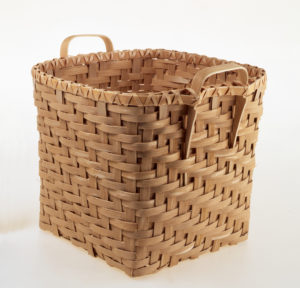
Image: Corn-Washing Basket
Cecilia Sunday (1919- ), St. Regis, Quebec, Mohawk, 1993
Among the Iroquois, the most common way to prepare corn is to make hominy.
First the kernels are boiled in water mixed with hardwood ashes to loosen
the hulls. Then they are dunked up and down in water in a special washing
basket until the loosened hulls and ashes finally float free. The sieve-like
base and tightly woven sides allow the water to drain from the bottom while
the corn remains in the basket.
Black ash (Fraxinus nigra); L 31.0 x W 28.3 x H 25.7 cm); 35654-1 |