North-South-East-West: American Indians and the Natural World
The Tlingit of the Northwest Coast
The coastal Tlingit people live on the beaches and islands in the
southeastern Alaska Panhandle, tucked between the tidewater and the
rugged coastal mountains. Heavy rainfall creates a luxurious
rainforest environment and a temperate climate more like Seattle
than Anchorage. The numerous islands create a protected waterway,
called the Inland Passage, that permits travel and communication by
water.
The Tlingit are the northernmost nation of the Northwest Coast
peoples, who range from southern Alaska to the coast of Oregon.
These coastal groups created luxurious societies founded upon the
abundant resources of the forest and the sea.
To this day, the livelihood of the Tlingit continues to be linked to the
bounty of the natural world. The people maintain interests
in
both fishing and forestry, industries that have
supported the Tlingit for centuries.
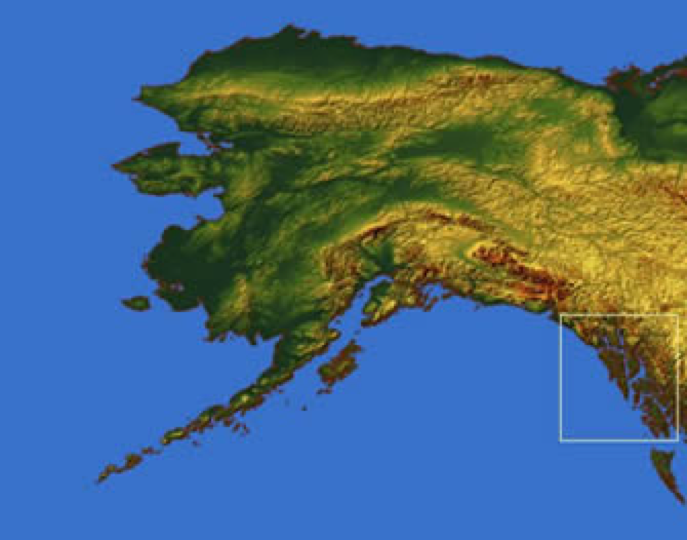
Image 1: Map
Southeast Alaska: The coast of southeast Alaska, with its islands, inlets,
estuaries, fjords, and rivers, is the home of the Tlingit people.
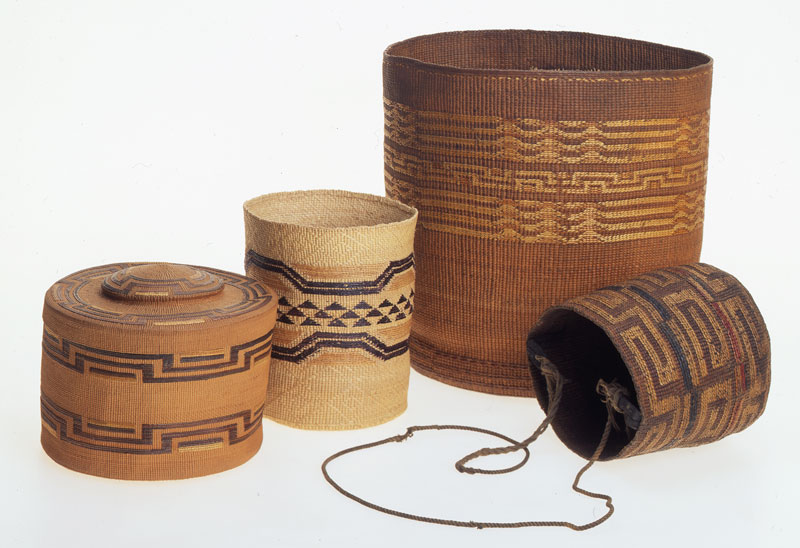
Image 2: Baskets, left to right
Trinket Basket
Tlingit, pre-1923
Sitka spruce (Picea sitchensis) root, unidentified
grass, pebbles?, dye; H 14.5 x D 17.2 cm; 8946-11a & b, gift of H.J. Heinz
Basket
Ernestine Hanlon, Tlingit, Leineid (Raven-Dog Salmon) Clan, Hoonah, Alaska, 1995
Sitka spruce root (Pisea sitchensis), unidentified grass, natural dyes; H
15.5 x D 14.0; 35989-1
Basket
Tlingit, collected 1904
Sitka spruce root (Pisea sitchensis), unidentified grass; H
27.3 x D 28.2; 3167-57
Berry Basket
Tlingit, collected 1904
Sitka spruce (Picea sitchensis) root, unidentified
grass, commercial cotton, dye; H 17.4 x D 13.8 cm; 3167-16
Tlingit women acheived fame for their finely twined spruce root baskets
decorated with dyed grass applied in a technique termed "false embroidery."
Wealthy basket collectors sought to augment their collections with Tlingit
examples. |